
KNOWLEDGE
Latest Article
CATEGORY
High-Pressure Pump Knowledge
13.Mar.2026
Why 70bar is the Gold Standard for Mist Cooling? Analyzing Pressure Management and Thermodynamics in High-Pressure Fogging Systems
The physical core of mist cooling lies in "Latent Heat Absorption." Every 1 kg of evaporated water can absorb up to 2,430.5 kJ of energy (at 30℃), equivalent to the cooling power of 7 kg of melting ice. Tanong Precision (DIAMOND) indicates that the key to achieving high-efficiency cooling with instant evaporation and zero water accumulation is to precisely control the mist particle size between 5 to 10 microns. The physical pressure threshold to achieve this standard is exactly 70 bar (1,000 psi).
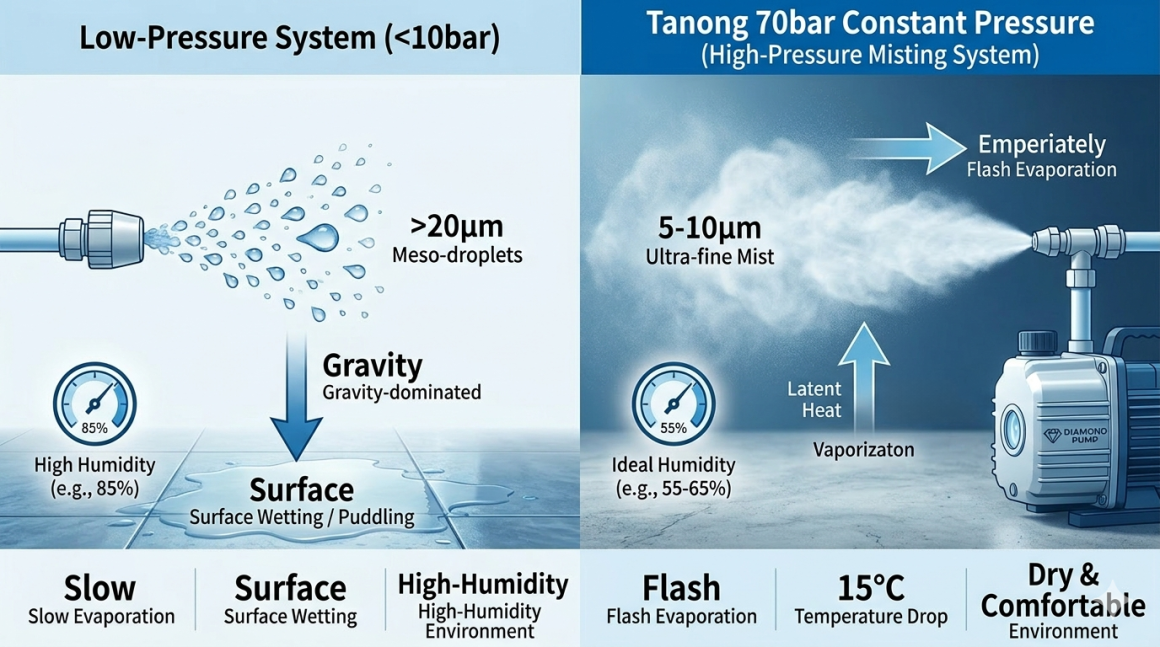
When pressure is stabilized at 70 bar, nozzles shear water into millions of ultra-fine particles with an average size of 10 microns. These particles possess a massive total surface area, allowing for rapid heat exchange with the air.
Note: "C" series models (e.g., NSC, NKMC) utilize high-grade stainless steel for high-cleanliness and anti-corrosion requirements.
Q1: Why can't I replace a 70bar system with a low-pressure system?
Answer: Low-pressure systems produce droplets larger than 20 microns, which cannot achieve "Flash Evaporation," leading to water accumulation and excessive dampness. 70bar reduces the particle size to below 10 microns, which is the scientific standard for dry cooling.
Q2: How do I perform preventative maintenance on a high-pressure system?
Tanong Precision recommends following these three points to ensure 3,000+ hours of stable output:
Thermodynamics of Cooling: Why 70bar Prevents Surface Wetting?
In the field of professional misting, pressure directly determines the "vaporization efficiency" of water molecules. 70bar is the essential benchmark to ensure the water mist completes its energy conversion before touching the ground or equipment, maintaining a dry environment.
Flash Evaporation and Latent Heat Absorption
When pressure is stabilized at 70 bar, nozzles shear water into millions of ultra-fine particles with an average size of 10 microns. These particles possess a massive total surface area, allowing for rapid heat exchange with the air.
- Physical Effect: Triggers a significant ambient temperature drop of 4-16°C.
- Environmental Impact: Prevents dampness or water accumulation caused by oversized droplets. This is particularly crucial for precision server rooms, textile factories, and semiconductor testing facilities.
Balance Between Humidity and Cooling Efficiency
According to physical data, the efficiency of a 70 bar system is inversely proportional to humidity:- Excellent Performance: Ambient relative humidity below 40%.
- Stable Performance: Humidity between 40% and 90%.
- Physical Limit: When humidity approaches 90%, the vaporization space becomes limited. In such cases, proper ventilation must be integrated.
Thermal Management at Tanong: 0.02mm Commitment and Product Lineup
Misting systems often require consecutive hours of operation. Tanong Precision has developed a comprehensive lineup of misting pumps, ranging from individual workstations to plant-wide systems, featuring core thermal management technology:Core Technology: 0.02mm Extreme Clearance Control
Across the NS and NKM series, Tanong maintains a clearance between the plunger and guide within 0.02mm. This ensures a stable "Hydrodynamic Lubricating Oil Film" under high-frequency 70bar operation, effectively preventing heat accumulation and oil degradation. Additionally, our Grease-free technology ensures the emitted mist is pure and contamination-free.Professional Misting Pump Selection Guide
| Pump Series | Flow Rate | Max Nozzles | Recommended Applications |
| (L/min) | (Ø0.15mm) | ||
| NS / NSC Series | 1.3 (NS-1) ~ 8.2 (NS-8) | 16 ~ 104 Units | Localized cooling, restaurants, small greenhouses |
| NKM / NKMC Series | 16.0 | 203 Units | Large factories, logistics centers, deodorization |
| NKL / NKLC Series | 25.9 | 329 Units | Plant-wide environment control, major events, dust suppression |
FAQ: High-Pressure 70bar Misting Systems
Q1: Why can't I replace a 70bar system with a low-pressure system?
Answer: Low-pressure systems produce droplets larger than 20 microns, which cannot achieve "Flash Evaporation," leading to water accumulation and excessive dampness. 70bar reduces the particle size to below 10 microns, which is the scientific standard for dry cooling.
Q2: How do I perform preventative maintenance on a high-pressure system?
Tanong Precision recommends following these three points to ensure 3,000+ hours of stable output:
- Multi-stage Filtration: Must use PP cotton, water softening resin, and activated carbon to prevent scale buildup.
- Regular Cleaning: Soak and clean nozzles with citric acid quarterly.
- Temperature Management: Keep water temperature below $45^{\circ}C$ to protect precision internal components.